

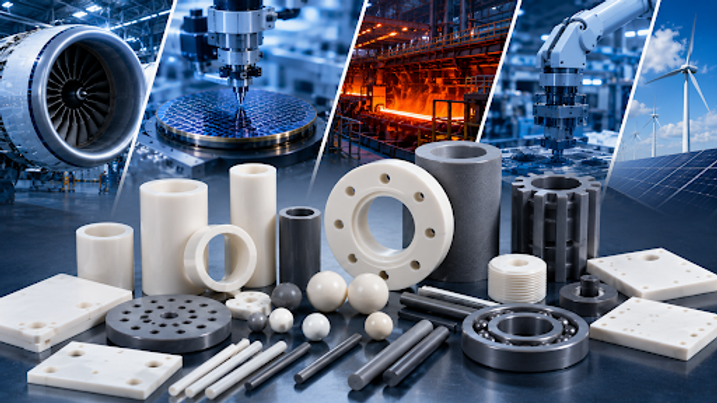
When normal materials cannot be used to meet the strength, heat resistance, wear resistance, electrical performance, and chemical stability requirements, advanced ceramics are used. But the selection of the right ceramic is not just about the hardest or the most heat-resistant ceramic. The properties of various ceramic materials are different, and the selection of the material should take into account the working environment, component design, manufacturing process and performance expectations. Consider these factors, and material selection will be more practical, and problems will be minimized in production.
Identify the Main Application Requirements
The first question is always, “What does the ceramic component need to do? Other parts experience very high temperatures, or have to withstand friction, electrical loads, chemical exposure, or dimensional restrictions.
For instance, a ceramic that is an electrical insulator would have different requirements than one used in a high-wear mechanical part. Identify operating temperature, mechanical loading, chemical exposure, electrical properties and service life before choosing a material. These details will be helpful in narrowing down the choices of ceramics that are suitable.
Compare Strength, Hardness, and Toughness
Strength and toughness are important properties of ceramics, in addition to hardness and resistance to wear. Hardness can make a component more resistant to scratching and surface wear, while strength is the resistance to applied loads.
Toughness is especially important if the component is likely to be impacted, vibrated or subjected to sudden changes in loading. A material which has a very high hardness rating may not be suitable if it is to be subjected to mechanical shocks in the application. Hence, the entire operating environment is taken into account and not just one material property.
Consider Temperature Performance
The selection of ceramics is greatly affected by the requirements for temperature. Conventional materials may soften, oxidize or change other properties at elevated temperatures, but many advanced ceramics will continue to have useful properties at these temperatures.
But resistance to temperature is not the only factor. Thermal stresses can also be caused by repeated heating and cooling. Differences between a ceramic’s thermal expansion and the materials surrounding it may contribute to cracking or dimensional changes.
When purchasing a material for high-temperature equipment, the maximum operating temperature and thermal cycling conditions are therefore important factors to take into account.
Check Chemical and Wear Resistance
Components can be subject to acids, alkalis, solvents, gases, abrasive particles or other aggressive substances in an industrial environment. Resistance to many types of chemical attack can be excellent for ceramic materials, depending on their composition and use.
In parts that are subjected to constant rubbing or abrasive substances, wear resistance is also very significant. Depending on the application, such as pumps, seals, processing, cutting or protective surfaces, a ceramic with certain hardness and wear properties may be needed.
If you know what kind of exposure you are looking for, it will be easier to pick the right ceramic than to settle for a ceramic based on its general reputation.
Review Manufacturing and Component Design
The shape and size of the component may influence the material selection. The choice of ceramic may be affected by complex geometries, thin sections, tight tolerances, holes, surface finishes and joining requirements.
Discussion of manufacturing should be addressed at the early stages of the process. Some of the parts may need to be machined after sintering, and some parts can be formed by special forming methods. When a component requires custom dimensions or special characteristics, a knowledgeable Advanced Ceramics Manufacturer can help determine the feasibility of the component’s production.
Consider Availability and Quality Requirements
Material availability can quickly mess up your project timelines and overall budget, especially for unique industrial jobs. Because of this, customers really need to check if the exact grade, size, purity and amount they need will be available consistently.
Having the right quality paperwork matters a lot too. What you build changes things a lot, so you might need clear papers for parts, strength, shop rules, actual size, or lab tests. These details will be useful for internal quality control and consistency of production batches.
Balance Performance with Project Cost
While a high-performance ceramic can deliver great performance, it may not always be required. It is better to determine the properties that will directly influence the application and then choose a material that has the desired properties.
When businesses Shop Advanced Ceramic Materials, they should compare technical suitability, manufacturing requirements, availability and total project cost together. This avoids both under-specifying and unnecessarily over-specifying the material.
Conclusion
There are more factors to consider when selecting an advanced ceramic than just comparing material properties. It depends on application conditions, temperature, mechanical loads, chemical exposure, wear, manufacturing requirements, availability and cost. Knowing these factors can assist in choosing a ceramic that will reliably function in the application. For companies interested in any special ceramic options, they can visit regmetals.com to see what materials are available and how they can be sourced. If the application requirements are known, it makes discussions with suppliers more fruitful and will result in a more appropriate material selection.