

Choosing between a hardware wallet and a software wallet is one of the most important security decisions for anyone managing cryptocurrency. Both can provide access to digital assets, but they protect private keys in fundamentally different ways.
A software wallet stores and manages keys through an application on a phone, computer, or browser, making it convenient for frequent transactions. A hardware wallet, by contrast, is designed to keep private keys isolated from everyday internet-connected environments. This makes the hardware wallet vs software wallet decision particularly important for users holding significant crypto balances or prioritizing long-term security.
The right option depends on how often you transact, how much risk you are willing to accept, and whether convenience or stronger isolation is your priority.
What Is a Software Wallet?
A software wallet is a cryptocurrency wallet that operates through an application, browser extension, or mobile platform. It allows users to send, receive, and manage digital assets directly from an internet-connected device.
Software wallets are popular because they are convenient and generally quick to set up. They can be particularly useful for active traders, decentralized applications, and users who regularly interact with Web3 platforms.
However, the device running the wallet can introduce security risks. Malware, phishing attacks, malicious browser extensions, compromised applications, or unauthorized access to the device may expose sensitive wallet information.
This does not mean software wallets are inherently unsafe. A well-maintained device, strong authentication, careful transaction verification, and secure backup practices can significantly reduce risk. Nevertheless, the security of the wallet is closely connected to the security of the environment in which it operates.
What Is a Hardware Wallet?
A hardware wallet is a dedicated device designed to protect cryptocurrency private keys. Instead of relying entirely on the security of a general-purpose computer or smartphone, it uses specialized hardware to isolate sensitive key operations.
A crypto hardware wallet can be particularly useful for users who want stronger protection against online threats while maintaining control of their assets.
One important security principle is that private keys should remain protected even when the device used to initiate a transaction may be exposed to the internet. Hardware wallets are designed around this principle.
Some modern hardware wallets use secure elements to provide hardware protected private keys, adding another layer of protection against unauthorized extraction or manipulation.
Hardware Wallet vs Software Wallet: Key Security Differences
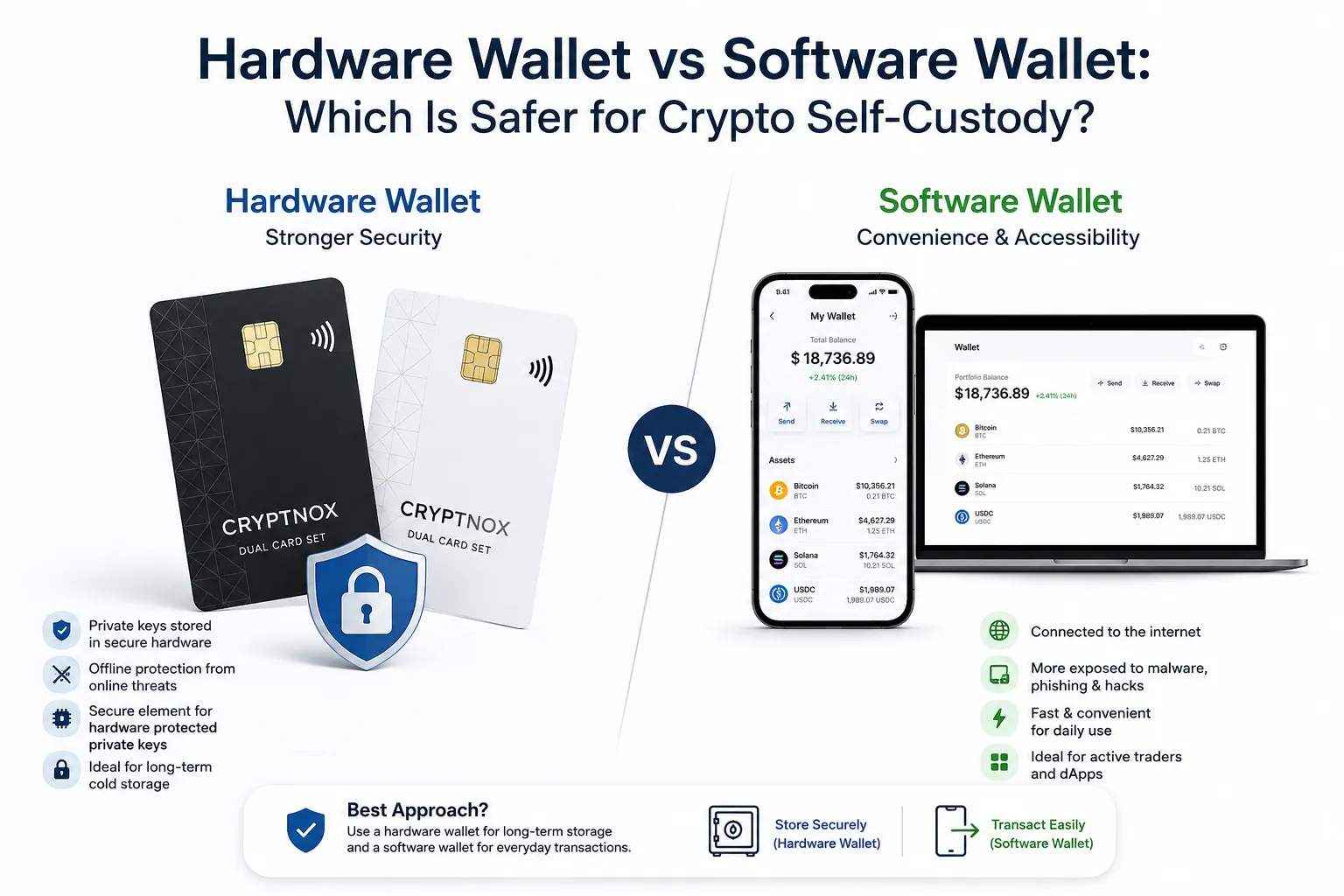
When comparing a hardware wallet vs software wallet, the biggest difference is how private keys are protected.
A software wallet typically operates within an environment that may be connected to the internet. A hardware wallet is designed to isolate sensitive key material from that environment.
Here are the main differences:
-
Private-key exposure: Software wallets operate on computers or mobile devices, while hardware wallets are designed to keep key material within dedicated hardware.
-
Online attack surface: Software wallets can be more exposed to malware, phishing, and compromised applications.
-
Transaction security: Hardware wallets generally require users to interact with a dedicated device when approving transactions.
-
Convenience: Software wallets are usually faster for everyday transactions and Web3 interactions.
-
Long-term storage: Hardware wallets are generally better suited to users prioritizing long-term asset protection.
-
User responsibility: Both wallet types require secure backups, strong passwords or authentication, and careful transaction verification.
Why Hardware Wallets Are Often Preferred for Long-Term Storage
For users holding cryptocurrency for months or years, reducing exposure to online threats becomes increasingly important.
A cold storage wallet is designed around keeping cryptocurrency keys away from continuously connected environments. Hardware wallets are commonly used as part of this cold-storage strategy.
Consider an investor who purchases Bitcoin or Ethereum periodically and rarely moves those assets. Using a software wallet on a daily-use laptop may create unnecessary exposure because that laptop is also used for browsing websites, downloading files, checking email, and accessing other services.
A dedicated hardware wallet can separate the security of cryptocurrency keys from those everyday activities.
This is one reason hardware wallets are often recommended for larger holdings and long-term self-custody.
When a Software Wallet May Make More Sense
Software wallets still have an important role in cryptocurrency.
For example, someone frequently using decentralized exchanges, blockchain games, NFT marketplaces, or Web3 applications may prioritize accessibility. A mobile or browser-based wallet can make signing transactions faster and more convenient.
Software wallets can also be useful for holding smaller amounts intended for regular spending or experimentation.
A practical approach for some users is to use different wallets for different purposes: a software wallet for everyday activity and a dedicated hardware wallet for assets intended for longer-term storage.
Hardware Wallet Security Still Requires Good Practices
Buying a hardware wallet does not eliminate every security risk. Self-custody means the user remains responsible for protecting access to their assets.
Important practices include:
-
Purchase hardware wallets from trustworthy sources.
-
Keep recovery information offline and protected.
-
Never share private keys or recovery phrases.
-
Verify transaction details before approving them.
-
Be cautious of phishing websites and fake wallet applications.
-
Keep wallet software and firmware updated when appropriate.
-
Avoid entering recovery information into websites or unknown applications.
-
Maintain a secure backup strategy.
A self-custody hardware wallet can provide strong technical protection, but operational security remains equally important.
Which Is Safer: Hardware Wallet or Software Wallet?
For pure private-key isolation and long-term cryptocurrency storage, a hardware wallet will generally provide stronger protection than a software wallet operating on an everyday internet-connected device.
However, “safer” depends on the user’s behavior and requirements. A poorly managed hardware wallet can still result in lost funds, while a carefully secured software wallet can be appropriate for smaller balances and everyday transactions.
The most important distinction is the threat model. If the priority is minimizing exposure to online attacks and protecting substantial cryptocurrency holdings, dedicated hardware protection is usually the stronger choice. If accessibility and frequent transactions are more important, a software wallet may be more practical.
Conclusion
The hardware wallet vs software wallet decision ultimately comes down to the balance between security, convenience, and how you use cryptocurrency. Software wallets offer accessibility and are well suited to frequent transactions and Web3 applications, while hardware wallets provide an additional layer of isolation for protecting private keys.
For long-term holders, investors, and users prioritizing self-custody, dedicated hardware protection can significantly reduce exposure to many common online threats. The strongest setup also depends on responsible backup practices, transaction verification, and protection of recovery credentials.
Understanding these differences allows crypto users to choose a wallet strategy that matches their risk tolerance rather than simply choosing the most convenient option.